
How to Build an AI Competitive Intelligence Pipeline: The Ingestion Problem
When people picture an “AI-powered monitoring system,” they picture the AI part: a model reading articles and writing sharp summaries. That’s the easy part. The hard part, the part that determines whether the tool works in production, is everything that happens before. It’s getting reliable, comparable data out of a set of sources with varying access and permissions.
We built a pipeline like this for a client. It watches news sites, RSS feeds, authenticated sources, and social accounts, scores what it finds against each user’s keyword watchlist, summarizes the relevant items, and delivers a personalized digest on a schedule. The AI summarization step is almost an afterthought compared to the engineering required to get there.
Every source is different, and not just in format
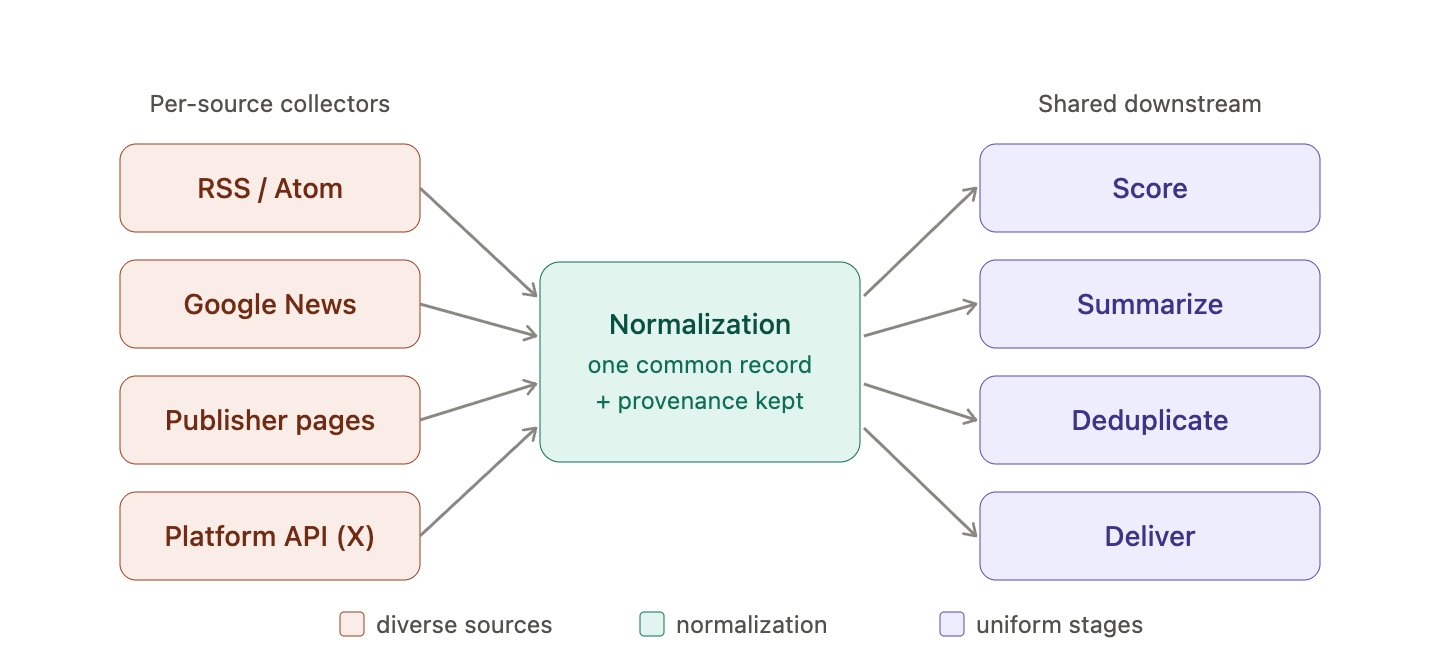
The system draws from several distinct acquisition channels: RSS and Atom feeds, search and aggregation services such as Google News, public and authenticated publisher pages, and platform APIs or browser-rendered sources such as X. These channels differ along more than one axis: not just the shape of the data they return, but how content is discovered, accessed, authenticated, and retrieved. Feed formats like RSS and Atom give you a more standardized starting point, though publishers still vary in which fields they populate and whether they carry the full article or only an excerpt. An aggregator like Google News is a discovery channel: it surfaces an item, while the publisher’s own page remains the authoritative source for the full text. A licensed or subscription publisher source, reached under its own credentials, might return raw HTML you still have to parse by hand. A platform API or event stream has its own schema, its own quirks, its own access model. None of these agree on a format, and none were built with each other in mind.

Authenticated access carries obligations
Authenticated sources also carry obligations that pure parsing does not. A pipeline that accesses content under a set of credentials must store those credentials securely and rotate them, handle session expiry and refresh, keep one user’s or tenant’s access isolated from another’s, and revoke access cleanly when someone leaves. There is also an entitlement question that sits alongside collection: access to a source and the right to reuse its content inside a digest are separate permissions, so a pipeline built responsibly treats each source’s terms, and any license governing reuse, as a design input rather than an afterthought. In practice that shapes the output as much as the collection: the digest summarizes and attributes rather than reproduces, and every item links back to the article on the publisher’s own page rather than standing in for it.

Contain the differences at ingestion
The design decision that matters here isn’t which collector to use for which source. It’s that none of that diversity is allowed to leak past the point of ingestion. Every source has its own collector, code that knows how to talk to that one source and pull data out of it, but the moment a collector hands data off, everything downstream consumes the same structure. Scoring, summarization, deduplication, and delivery don’t depend on whether an article came from RSS or a parsed HTML page; they read the same normalized record every time. The goal is to remove coupling to each source’s format, not to throw away source awareness. Provenance and policy metadata (which source an item came from, how authoritative it is, how it may be used) travels with the record, because scoring may weight an official filing differently from a repost, summaries need links and attribution, delivery has to honor each user’s entitlements, and debugging needs to know which collector produced a given item.
This matters more than it sounds like it should. The alternative, letting each source’s quirks ripple through the rest of the system, is how you end up with five almost-identical versions of your scoring logic, each subtly different, each breaking in its own way when something upstream changes. Adding a sixth source type becomes a multi-week project instead of writing one new collector. The abstraction is boring engineering, and it’s also the thing that makes the system maintainable a year later instead of becoming unmanageable.
Reliable collection is a moving target
Some of these sources are harder to collect reliably than others, and that’s not a hypothetical; it shaped a real decision mid-project. The original data-collection provider handled proxy rotation and access reliability, but a new requirement surfaced partway through: one use case needed visual snapshots of competitor pages, not just the text, so changes could be tracked over time. The first provider had no screenshot API. The team switched to a provider that bundled browser automation, screenshot capture, and reliable page access under one service, and absorbed the switch mid-build because the requirement changed underneath them.
Beyond that one switch, access itself is the part that never fully stabilizes. Publishers increasingly deploy commercial anti-bot services that detect and throttle automated traffic. For a monitoring pipeline, the practical consequence is that not every source can be collected the same way, and some cannot be collected reliably at all without going through an official channel: an API, a licensed feed, or a paid data provider. The responsible design choice is to reach for those first. Where automated collection is appropriate, it means working within a site’s stated limits, honoring robots directives and rate limits, and identifying your traffic rather than disguising it. The honest framing is that source access is a moving target rather than a solved feature: what a given site permits, and how, changes over time, and the pipeline has to be re-evaluated against those terms as it does. This is less a technical contest to win than a set of constraints to keep designing within.

Social platforms: access as a budget decision
Social platforms deserve a separate note, because the access story has shifted materially. X in particular has overhauled its API pricing several times since 2023, eliminating its free tier for new developers and moving to a pay-per-use model in February 2026. For monitoring pipelines that need recurring, high-volume reads (tracking a set of accounts or keywords daily) the official API math often doesn’t work without an enterprise-tier contract, so platform coverage becomes a real budget-and-scope decision rather than a free default. The responsible options are to license the access you need, scope the use case to what the official API affordably allows, or decide the source isn’t worth it, rather than assuming high-volume platform data is simply there for the taking. Whatever the choice, it belongs in the design phase, not discovered after the pipeline is built.

Deduplication: the simplest thing that works
With multiple sources potentially picking up the same story (a press release covered by three different outlets, say) you need a way to avoid sending the same item to a user twice. The system uses the article URL as the dedup key. That’s it. No fuzzy title matching, no embedding similarity, no clustering. A URL is unique enough, stable enough, and cheap enough to check that it solves the actual problem without adding complexity the use case doesn’t need. Not every deduplication problem needs a sophisticated answer; the right level of complexity is the level the failure mode actually requires, and here, an article either has the same URL or it doesn’t.
Rethinking the ingestion layer
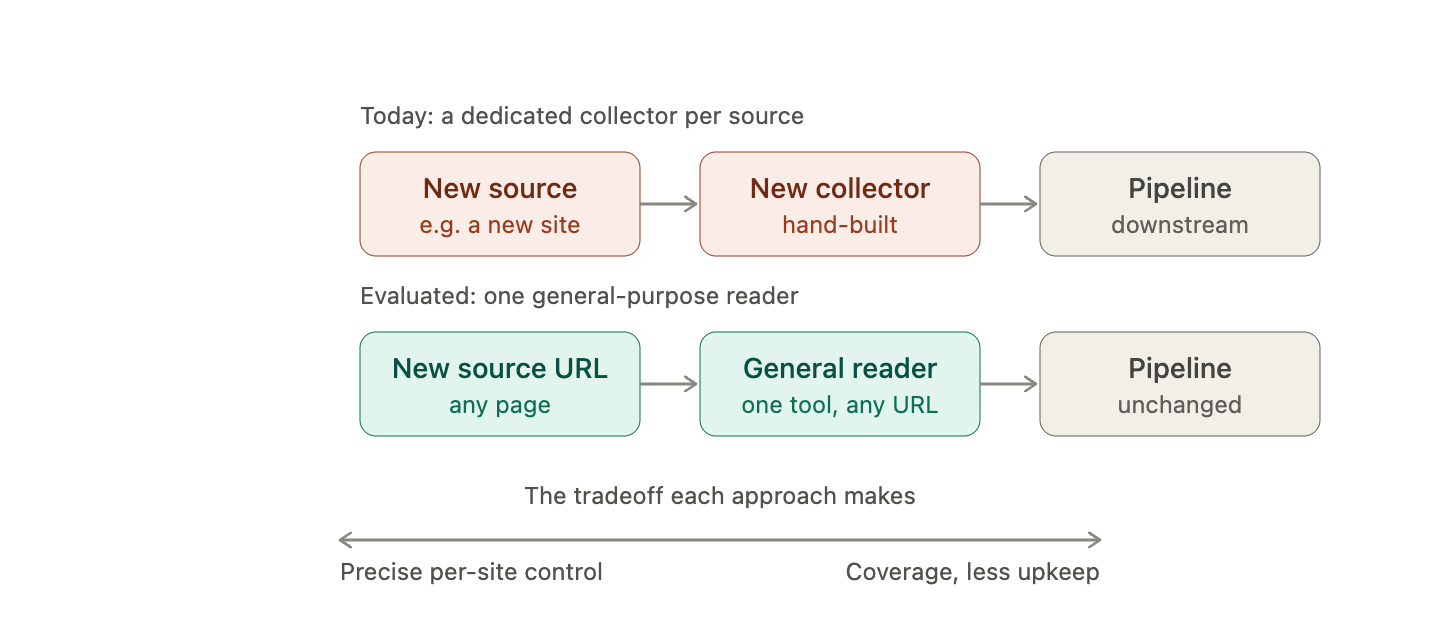
When the pipeline was first built, the ingestion layer worked the way most monitoring systems do: a dedicated collector per source type, each one knowing how to authenticate, paginate, and parse that specific source. That’s the pattern that produces the source abstraction described above, different collectors, identical downstream. It works. It’s maintainable. But it carries a cost: every new source type means writing and maintaining a new collector, which is engineering time every time the pipeline needs to expand.
The more recent question is whether that collector layer is still the right architecture. A newer class of tooling, purpose-built for feeding LLM pipelines, handles the fetch-and-clean step in a way that’s source-agnostic by design. Tools like Firecrawl take a URL and return clean Markdown or structured JSON, handling JavaScript rendering and page-access reliability as managed infrastructure rather than custom code. It’s worth being precise about the division of labor: the tool’s fetch-and-access layer is what retrieves the page, and the reading step is what removes the per-source parsing code. A model reading a page does not, on its own, obtain access it was not granted; access still has to come through legitimate means, whether an API, a license, or terms-compliant collection. The architectural question this raises is whether a general-purpose reading layer can replace the per-source collector: instead of writing a new collector for each new source type, you point the same tool at a new URL and let it work out the structure.
The appeal is real: collector maintenance is a standing overhead, and eliminating it would meaningfully reduce the cost of adding new sources. The tradeoff is that general-purpose extraction trades configuration control for coverage; a tool optimized for any URL is going to be less precisely tuned to a specific site’s structure than a hand-built collector. For competitive monitoring, where data quality and completeness matter more than raw throughput, that’s a real consideration rather than a footnote.
What doesn't change
What doesn’t change, regardless of which direction the ingestion layer goes, is the lesson underneath it. The AI is rarely the hard part of an AI-powered monitoring system. The hard part is getting trustworthy, comparable data out of sources that don’t agree on a format or collection method. Get that right, and the summarization step is almost the easy part by comparison.